5th Floor, Ratan Tata Innovation Hub, The Deck Building, VMRDA Siripuram, Visakhapatnam – 530003
Shed No. 10A, SDF-1, Phase-1, Visakhapatnam Special Economic Zone, Duvvada, Visakhapatnam – 530049
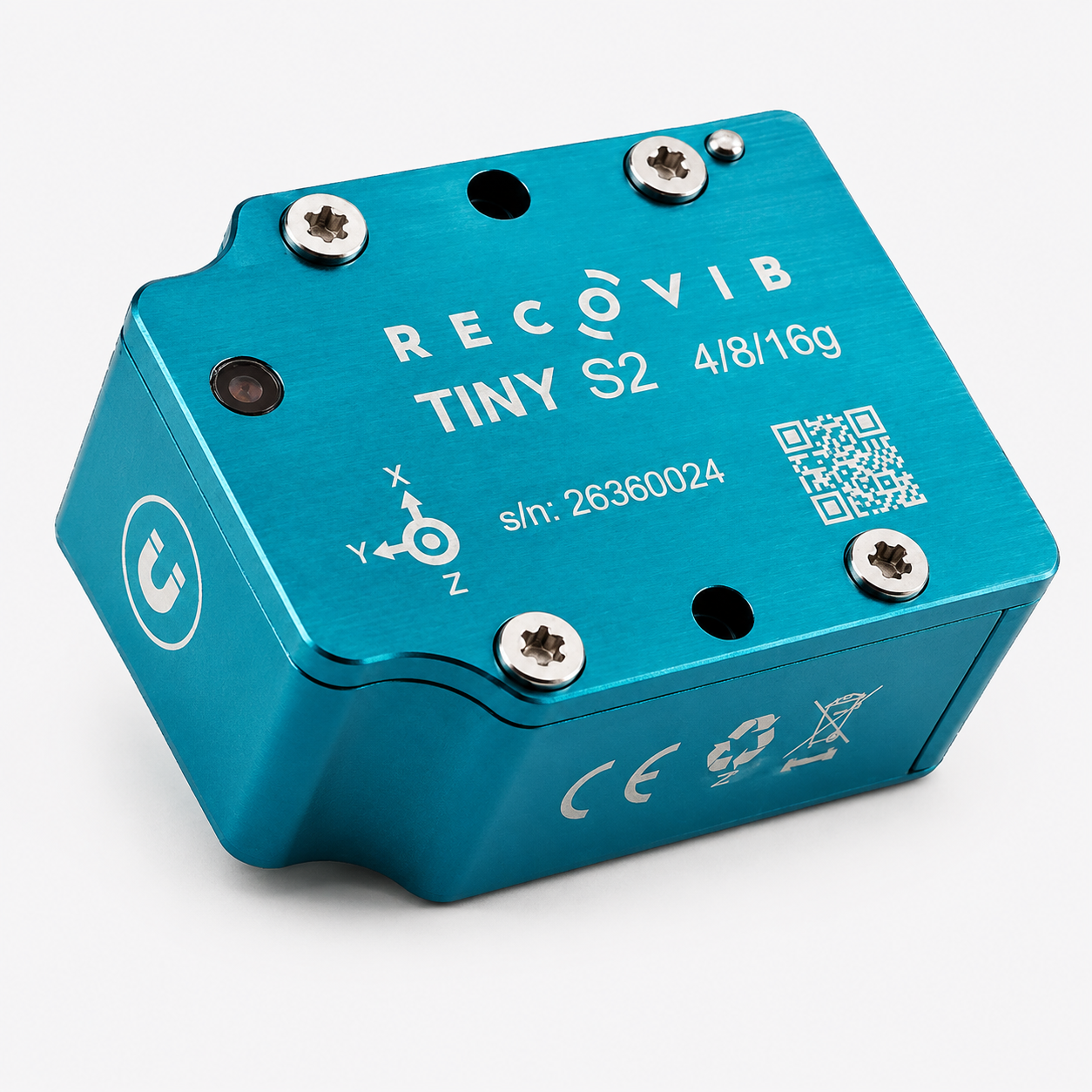
RecoVib Tiny S2 is a compact 3-axis wireless shock and vibration data logger engineered for high-precision vibration measurements, structural health monitoring, modal analysis, and machine diagnostics. Featuring configurable measurement ranges, up to 1 kHz useful bandwidth, synchronized multi-sensor operation, 24-hour battery autonomy, and an IP65 rugged enclosure, it delivers accurate, cable-free data acquisition for demanding industrial, automotive, aerospace, and research applications.
RecoVib Tiny S2 is a compact 3-axis wireless shock and vibration data logger designed for high-precision measurements. With synchronized multi-sensor operation, configurable sampling frequencies, IP65 protection, and autonomous data logging, it delivers reliable vibration analysis for structural monitoring, machine diagnostics, modal testing, and field measurements.
Capture vibration data wirelessly without cables during measurement.
Simultaneously measures vibration and shock across three independent axes.
Supports high-quality vibration measurements with configurable sampling rates.
Synchronize multiple sensors with less than 1 ms offset for advanced testing.
Long battery autonomy enables uninterrupted field measurements and data logging.
Supports continuous, periodic and threshold-triggered recording modes.
Compact aluminum enclosure built for demanding industrial and outdoor environments.
Export data to CSV, MATLAB®, LabVIEW® and analyze with RECOVIB Suite software.
RecoVib Tiny S2 is a compact wireless 3-axis shock and vibration data logger developed for high-precision vibration measurements in industrial, automotive, aerospace and structural monitoring applications. With configurable measurement ranges, sampling frequencies up to 4 kHz, useful bandwidth up to 1 kHz, and synchronized multi-sensor operation, it captures highly accurate vibration data without the need for cables during measurement.
Designed for autonomous operation, RecoVib Tiny S2 supports continuous, periodic and threshold-triggered recording modes, offers more than 24 hours of battery autonomy, IP65 protection, USB-C connectivity, onboard data storage, and seamless compatibility with the RECOVIB Suite for visualization, analysis and export to CSV, MATLAB® and LabVIEW®, making it an ideal solution for machine diagnostics, modal testing and structural health monitoring.

RecoVib Tiny S2 is engineered for portable vibration measurement, structural dynamics testing, shock analysis, modal testing and machine diagnostics. Its wireless design enables high-precision data acquisition across a wide range of industrial and research applications.
Measure vibration on motors, pumps, compressors and rotating equipment.
Capture vibration and shock data during vehicle testing and validation.
Analyze structural vibration and dynamic behaviour of aerospace components.
Monitor bridges, buildings and mechanical structures for vibration analysis.
Ideal for laboratory experiments, modal analysis and engineering research.
Supports predictive maintenance and machine diagnostics with wireless measurements.
Measure vibration simultaneously along X, Y and Z axes.
Capture high-frequency vibration and shock events with exceptional accuracy.
Perform cable-free vibration measurements for maximum flexibility.
Long battery autonomy enables extended field testing sessions.
Supports continuous, periodic and threshold-triggered recording.
Built for dependable operation in demanding industrial environments.
Visualize, analyze and export measurement data with dedicated software.
Export recorded data for advanced analysis and engineering applications.
Capture highly accurate vibration and shock measurements with the RecoVib Tiny S2 wireless sensor. Designed for structural dynamics, machine diagnostics, modal testing, and predictive maintenance, it provides synchronized multi-axis data acquisition, reliable wireless communication, and powerful analysis capabilities to help engineers improve equipment reliability, reduce testing time, and make smarter maintenance decisions.